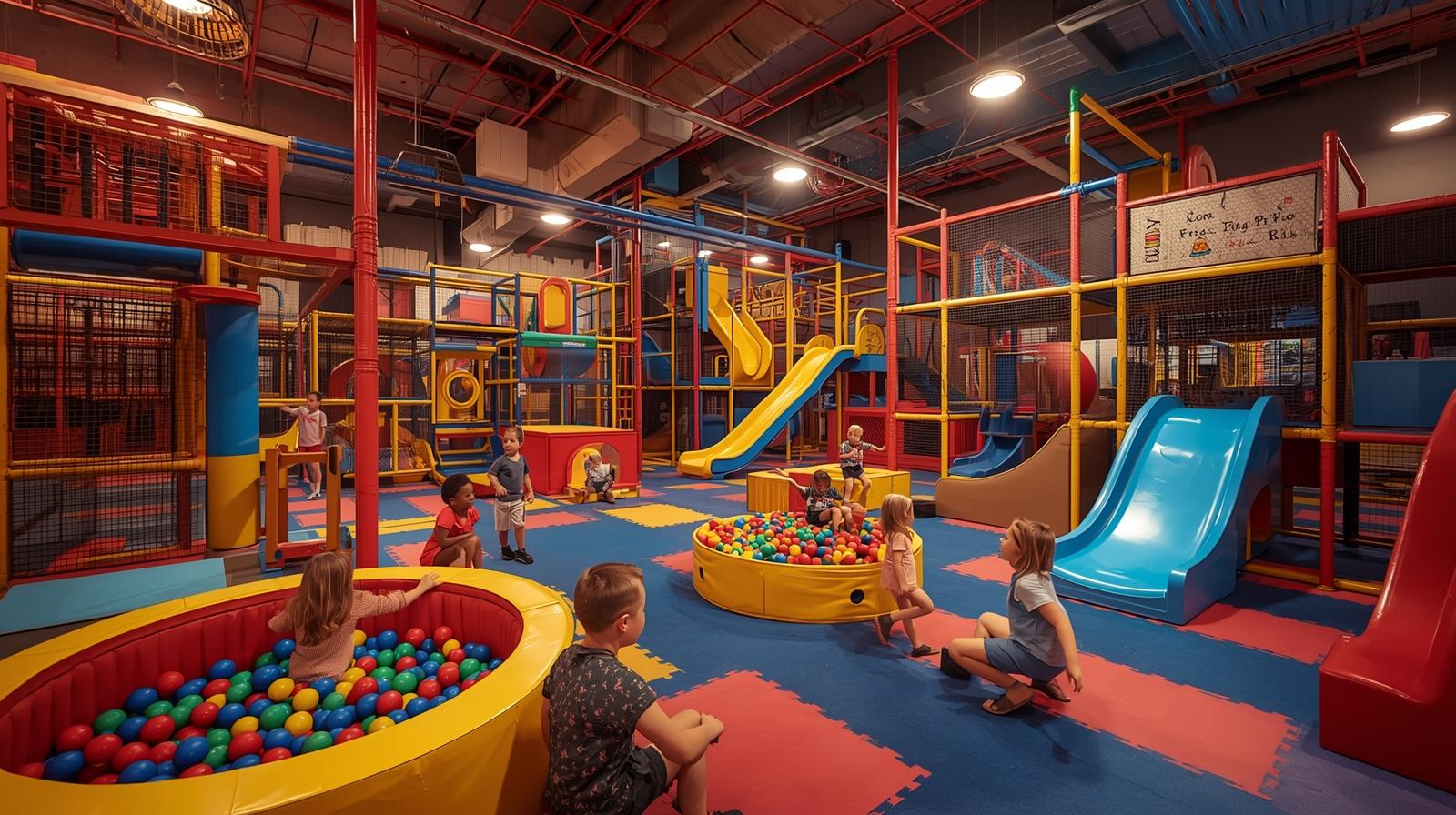
Indoor Playground Business Ideas
18 February 2026
Successful indoor playground business ideas focus on high-capacity attractions that keep families engaged while maintaining predictable operating costs, regulatory compliance, and year-round revenue stability.
Unlike outdoor or event-based entertainment, indoor playgrounds must perform every single day, regardless of weather, seasonality, or special events. This makes operational efficiency and durability far more important than novelty.
Why indoor playgrounds require a different business mindset
Indoor playground operators face unique constraints:
- fixed location and rent,
- recurring operating costs,
- daily staffing requirements,
- constant safety oversight.
As a result, indoor concepts that rely purely on visual novelty or low-cost equipment often fail to scale or maintain margins over time.
Indoor success is built on repeatability, throughput, and cost control.
What defines a strong indoor playground business model
1. High-capacity attractions over low-throughput play areas
Indoor environments reward attractions that:
- serve many users per hour,
- avoid long waiting times,
- operate continuously throughout the day,
- maintain stable performance under heavy use.
Low-capacity attractions may look appealing but quickly become bottlenecks during peak hours.
2. Repeat usage instead of one-time excitement
Indoor playground customers are typically:
- local families,
- returning visitors,
- members or pass holders. This means attractions must:
- remain engaging after multiple visits,
- offer variable levels of challenge or interaction,
- avoid quick saturation.
Repeatability directly reduces customer acquisition costs and stabilizes revenue.
3. All-weather, all-season monetization
One of the main advantages of indoor playgrounds is weather independence. Successful operators leverage this by:
- positioning the venue as a reliable fallback during bad weather,
- offering weekday and off-season programs,
- maintaining consistent operating hours year-round. Consistency is a major driver of long-term profitability.
4. Family-oriented experiences with broad appeal
Indoor playgrounds perform best when attractions:
- appeal to children of different ages,
- allow parents to observe or participate,
- support group and family-based visits.
Narrow age targeting reduces utilization and limits repeat visits.
Mechanical and semi-mechanical attractions vs soft play
While soft-play zones are common, many operators discover their limitations over time:
- high wear and tear,
- frequent cleaning and replacement,
- limited perceived value for older children,
- low differentiation from competitors. Mechanical and semi-mechanical attractions often:
- handle higher loads,
- last longer under intensive use,
- justify higher pricing,
- create stronger attraction “anchors” within the venue.
The most successful indoor playgrounds use a balanced mix, not a single category.
Durability and maintenance as profit drivers
Indoor attractions operate daily, which makes:
- material quality,
- maintenance cycles,
- spare parts availability, critical to long-term cost control.
Attractions that are cheap to buy but expensive to maintain silently erode margins month after month.
Compliance and safety in indoor environments
Indoor playgrounds operate under:
- strict safety regulations,
- frequent inspections,
- heightened parental scrutiny. This requires:
- equipment designed specifically for indoor public use,
- clear documentation and procedures,
- predictable inspection outcomes.
Compliance failures indoors are more damaging than outdoors because downtime affects daily revenue.
Staffing and operational simplicity
Indoor playground operators benefit from attractions that:
- use consistent operating procedures,
- minimize the need for specialized skills,
- allow flexible staff rotation,
- reduce training time.
Operational simplicity directly impacts profitability in fixed-location businesses.
Business conclusion
Successful indoor playground business ideas are not built on trends or decoration. They are built on:
- high-capacity attractions,
- repeatable experiences,
- durable equipment,
- predictable operating costs,
- compliance-ready design.
Indoor environments reward efficiency, reliability, and long-term thinking.
In indoor playgrounds, consistency beats novelty — and durability beats impulse decisions.