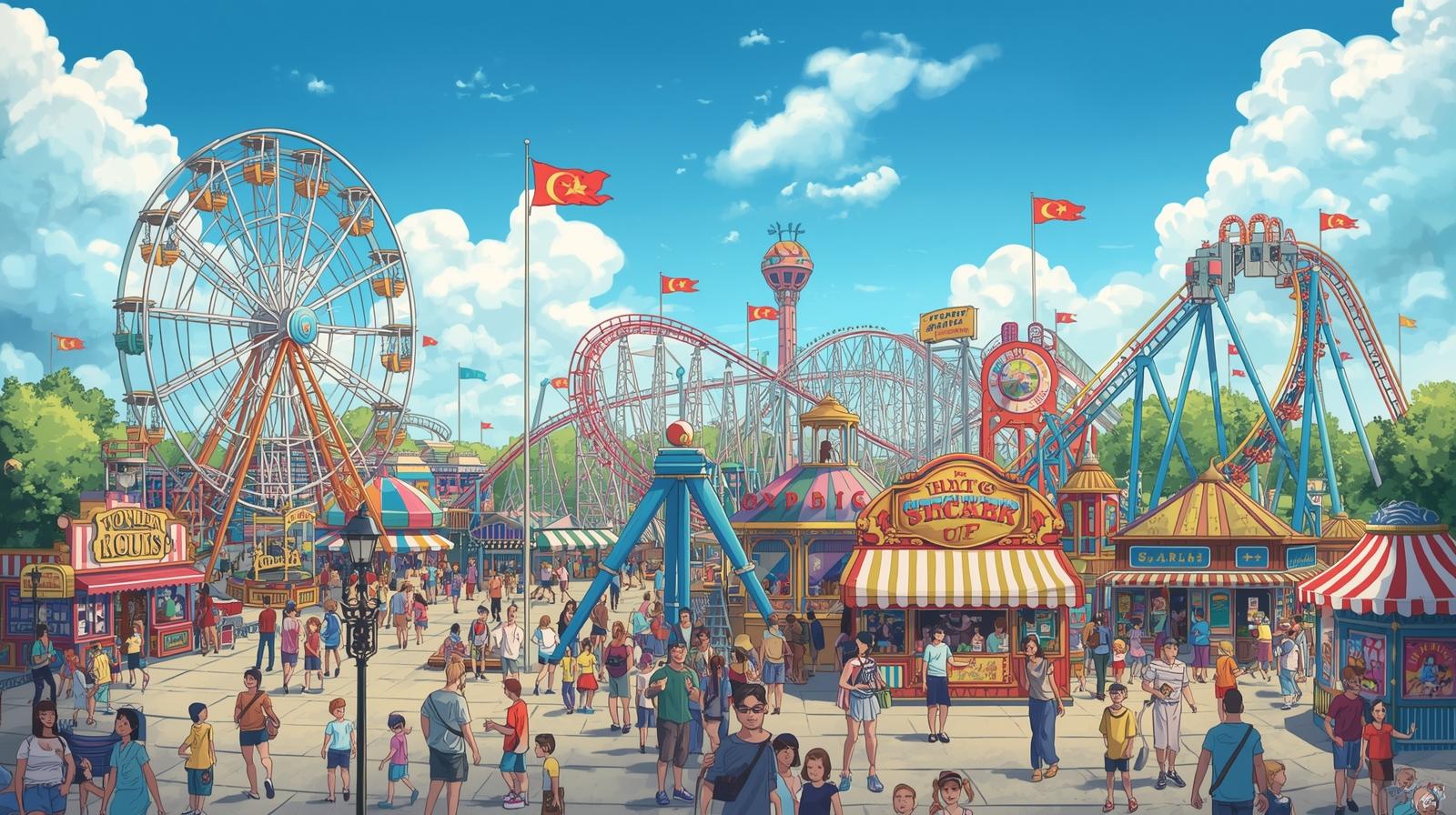
Amusement Park Ideas
18 February 2026
Modern amusement park ideas focus on modular, scalable attractions that allow operators to expand, reconfigure, or relocate their park without interrupting operations or locking capital into fixed infrastructure.
Today’s successful parks are not built around single, permanent installations.
They are designed as flexible systems that evolve with demand, seasonality, and budget.
Why modularity matters in modern amusement parks
From an operator’s perspective, modularity is no longer optional — it is a risk management strategy.
Parks that rely on fixed, non-scalable attractions face:
- high upfront capital expenditure,
- limited ability to test new concepts,
- operational downtime during upgrades,
- slow response to changing visitor demographics. Modular attractions allow parks to:
- start smaller and expand step by step,
- refresh the offer without rebuilding the park,
- relocate or resell assets if needed,
- adjust layout for events, seasons, or footfall patterns.
Core attraction categories used in modern parks
1. Multi-age, high-throughput attractions
Modern parks prioritize attractions that:
- serve children, teenagers, and adults,
- operate continuously throughout the day,
- maintain short ride cycles,
- justify premium pricing.
This significantly improves revenue per square meter and reduces dependency on niche age groups.
2. Attractions that act as visual anchors
Certain attractions are selected not only for revenue, but for visibility and park identity. These anchor attractions:
- are visible from a distance,
- attract first-time visitors,
- define the park’s image in marketing materials,
- increase dwell time and cross-traffic to other zones. A park without anchors struggles to differentiate itself.
3. Equipment designed for long service life
Modern amusement parks increasingly calculate:
- lifecycle cost instead of purchase price,
- maintenance cycles,
- spare parts availability,
- inspection and compliance longevity.
Attractions that look affordable upfront often become expensive over time due to downtime and replacement.
Compliance as a design constraint, not an afterthought
Public amusement parks operate under:
- regular inspections,
- insurance requirements,
- local authority approvals. This means attractions must be:
- designed for inspection from day one,
- supported with proper documentation,
- accepted by insurers across multiple seasons. Compliance-ready systems reduce:
- operational interruptions,
- last-minute event restrictions,
- long-term legal exposure.
Expansion strategy: how modern parks actually grow
Successful parks typically follow a phased model:
- Start with a flagship attraction that defines the park’s identity.
- Add complementary attractions that reuse existing staff and infrastructure.
- Expand capacity, not complexity.
- Refresh layouts, not foundations.
This approach allows parks to scale revenue without scaling risk.
Business conclusion
Modern amusement park ideas are not about building bigger parks — they are about building
smarter, more adaptable ones. Operators who prioritize:
- modularity,
- multi-age usability,
- compliance readiness,
- long-term operational efficiency,
create parks that remain profitable, insurable, and attractive to visitors year after year.