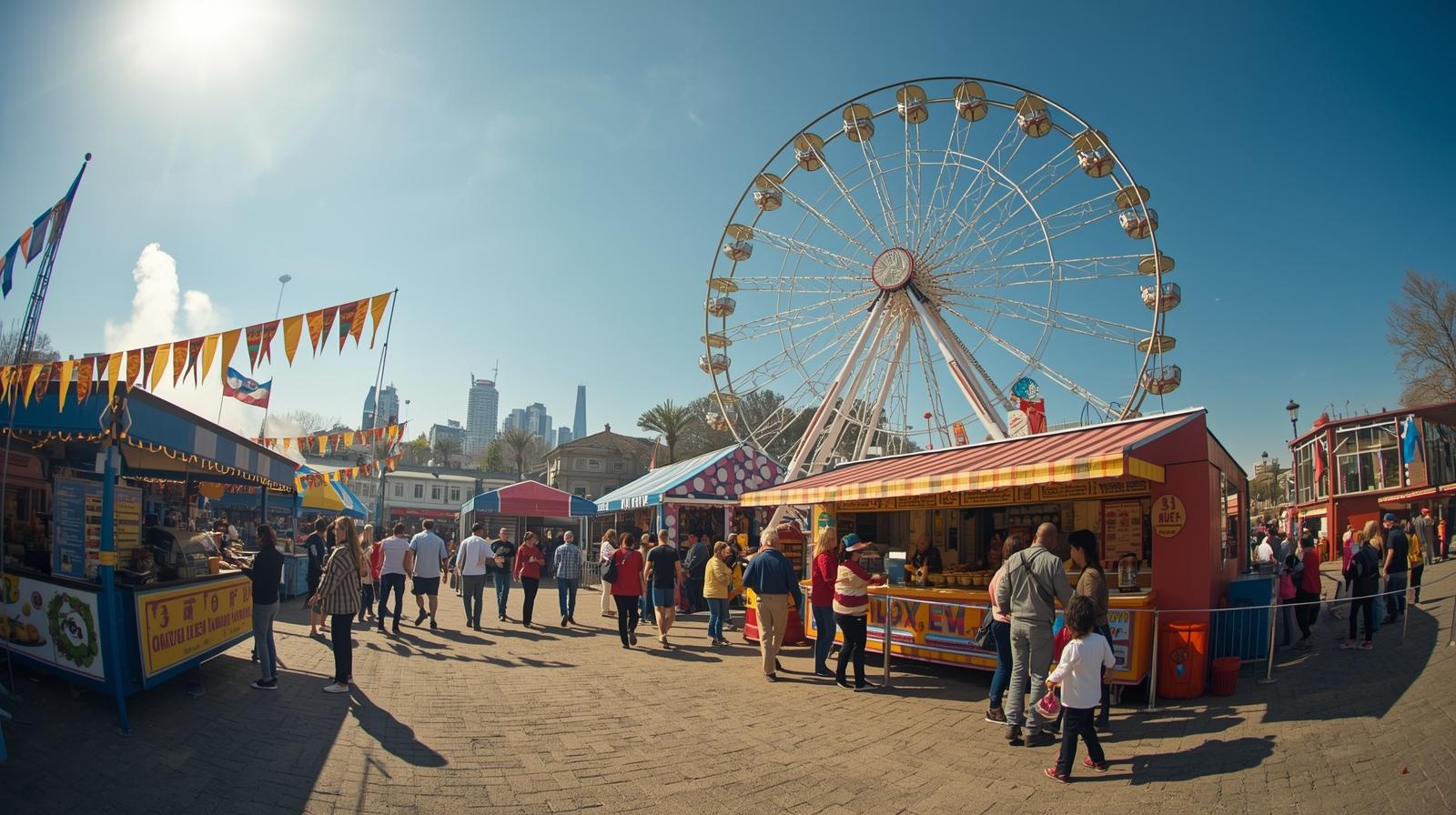
Best Outdoor Event Attractions
18 February 2026
The best outdoor event attractions are those that combine long-distance visual impact, certified safety for public environments, and high customer throughput with minimal operational downtime.
In outdoor events, success is not determined by how exciting an attraction looks up close, but by
how efficiently it performs under real event conditions.
Why outdoor events require a different type of attraction
Outdoor events operate under constraints that do not exist in controlled indoor environments:
- unpredictable weather,
- dense and dynamic crowds,
- strict public-safety oversight,
- limited setup and dismantling windows.
Attractions that work well indoors or in private venues often fail outdoors due to instability,
visibility issues, or inspection problems.
Core characteristics of top-performing outdoor event attractions
1. High visibility from a distance
Outdoor events are competitive environments. Attractions must:
- be visible above the crowd line,
- attract attention from across the event area,
- clearly communicate “this is the main attraction”.
Visual anchors pull foot traffic not only to themselves, but to surrounding zones and vendors.
- High throughput under continuous operation Outdoor events concentrate demand into short time windows. The most profitable attractions:
- operate continuously for many hours,
- have short ride or participation cycles,
- minimize loading and unloading time,
- avoid frequent resets or pauses.
Throughput — not novelty — determines event-day revenue.
3. Public-space safety and inspection readiness
Outdoor attractions operate in public, mixed-use environments, which means:
- inspections may happen without notice,
- multiple authorities may be involved,
- insurance conditions are strictly enforced. Professional organizers favor attractions that:
- are designed for inspection from day one,
- have clear documentation,
- require no ad-hoc adjustments to pass approval. Inspection-ready design reduces operational stress during events.
- Reliability in variable weather conditions Weather is one of the biggest risk factors for outdoor events. Strong outdoor attractions:
- are mechanically stable,
- tolerate temperature changes,
- are less sensitive to wind,
- do not rely on inflatable or temporary pressure systems. Reliability protects revenue when conditions are less than ideal.
Why event organizers prefer engineered attractions
From the organizer’s perspective, the ideal attraction:
- attracts crowds without causing bottlenecks,
- operates safely without constant supervision,
- enhances the event’s perceived quality,
- minimizes liability exposure.
This is why professionally engineered attractions consistently outperform improvised or consumer- grade solutions.
Scalability across different event formats
The best outdoor event attractions are not single-use assets. They scale across:
- city festivals,
- corporate outdoor events,
- seasonal markets,
- tourism and municipal celebrations.
Scalable attractions allow operators to reuse the same equipment across multiple formats without major adjustments.
Business impact for operators
Choosing the right outdoor event attractions results in:
- higher revenue per event day,
- fewer operational interruptions,
- smoother inspections and approvals,
- stronger relationships with event organizers,
- higher probability of repeat bookings.
Outdoor events reward consistency and reliability, not experimentation.
Business conclusion
The best outdoor event attractions are not defined by how creative they are — but by how
predictably and efficiently they perform in public environments. Attractions that deliver:
- strong visual presence,
- high throughput,
- inspection-ready safety,
- weather resilience,
consistently outperform alternatives in real-world outdoor events.
Outdoor events reward engineering, not improvisation.